|
Romania's Nine O'Clock reports the discovery — the first ever — of a Roman sarcophagus at ancient Porolissum, capital of Dacia Porolissensis. The limestone chest and lid apparently lack adornment and are clearly unfinished. Judging from the lid's four corner acroterial projections and its double-pitched roof, however, the carver was following eastern rather than metropolitan Roman models. This choice might seem a bit unexpected for a Latin-speaking province — but is perhaps less surprising in light of Porolissensis's Transylvanian location and proximity to eastern centers. The large notch cut in the lid, showing signs of discoloration, is intriguing. Perhaps a sign of reuse? Reuse might also account for the coffin's unusual find spot: not in the town's necropolis outside the Roman castrum, but rather "within the sacred area". (of Liber Pater? of Nemesis? We're not told.) 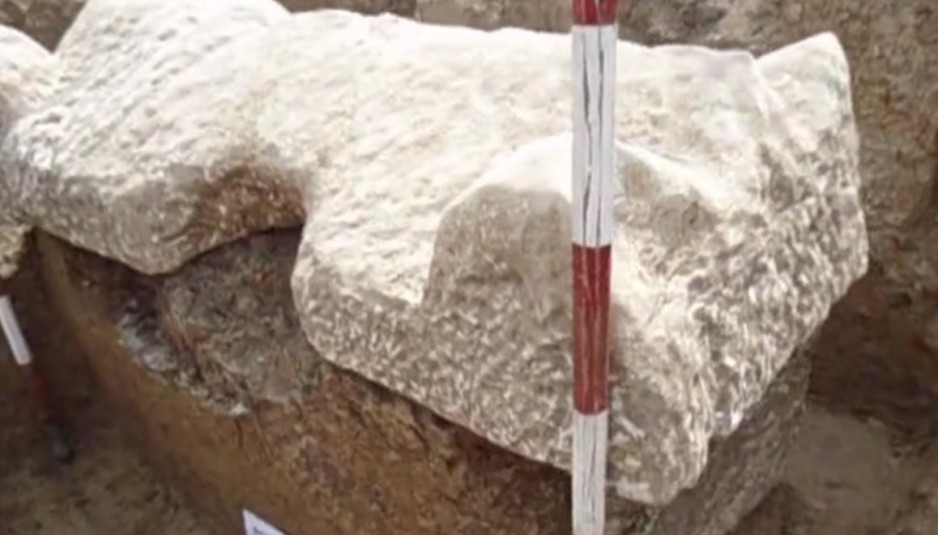
- Jaś Elsner, "Introduction".
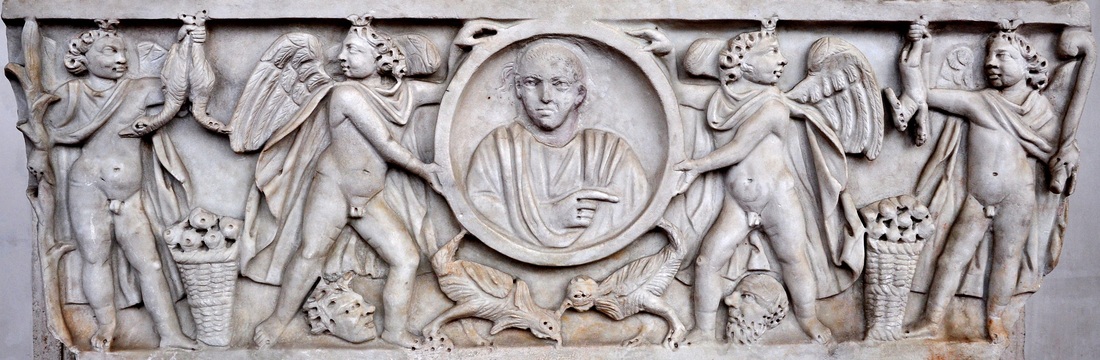 Season sarcophagus with recut portrait. Middle of the 3rd century AD. Rome, Baths of Diocletian. 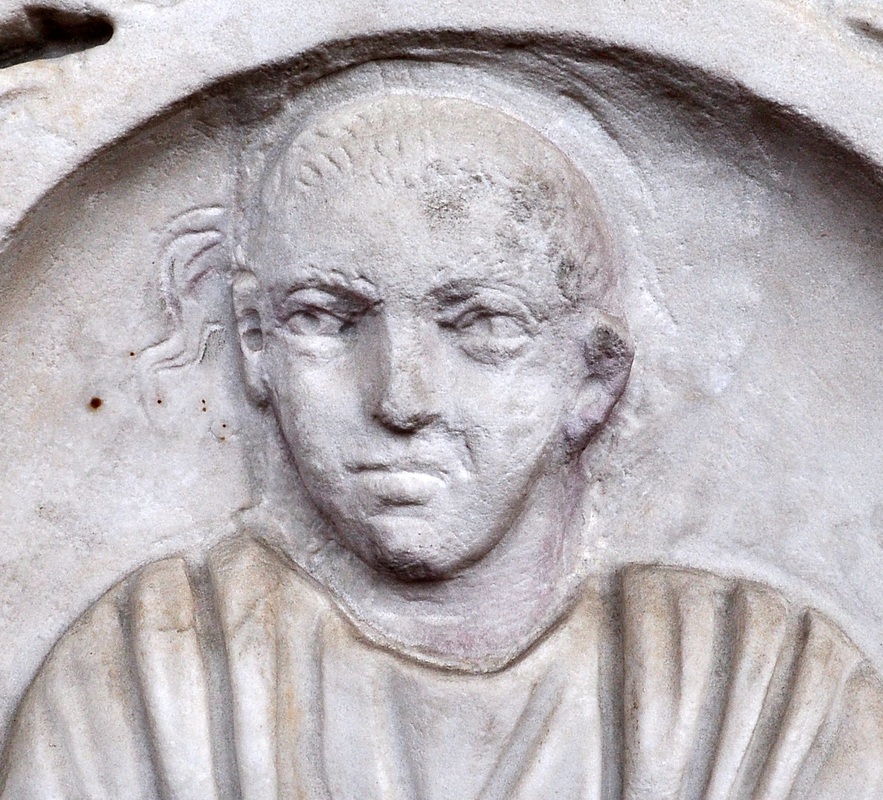 A previous post featured the mysterious case of the phantom ponytail — a Roman sarcophagus whose occupant, portrayed on the front, appeared to be sprouting phantasmic locks of hair from above his ear. I return to this marvelous piece because a recent trip to Rome has provided me with better photographs (above). These show the marks of recutting, and the ghostly traces of the prior owner's ponytail, in better light. Several readers asked me about the hairstyle of Isis's son Harpocrates, the mythic child whose coiffure was adopted by male devotees of Isis (including this coffin's original owner). Below is a photograph of a bronze statue of the wee god, now in San Francisco's Legion of Honor. Dated to the early 3rd century, it's roughly contemporaneous with our sarcophagus. You can't miss the prominent sidelock. 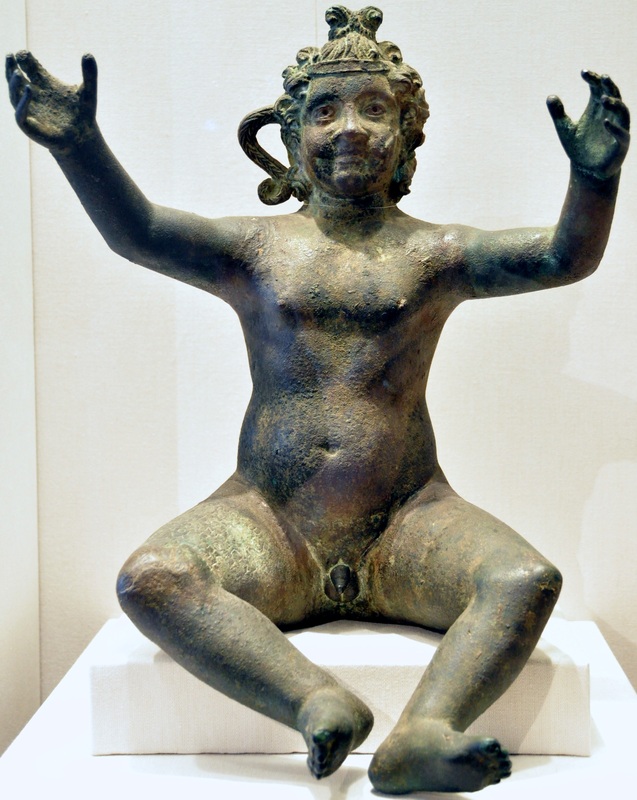 Bronze statue of Harpocrates. Early 3rd century AD. San Francisco, Legion of Honor (inv. 54666). Comments warmly invited. (Both the Facebook system below, and the traditional comment form, work dandily.) 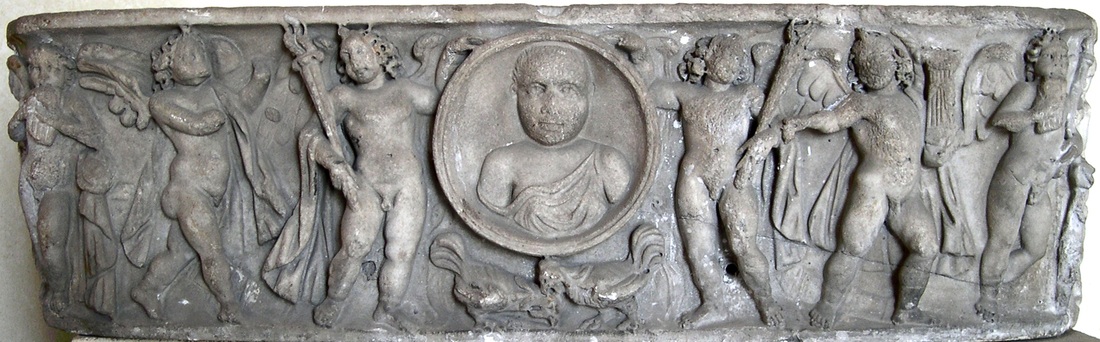 Child's clipeus sarcophagus with recut portrait. Third century AD. Rome, Vatican Museums, Galleria Lapidaria (inv. 9242). The small dimensions of this piece reveal that it was intended for a child. Given the high rates of infant and juvenile mortality in the ancient world (as in most pre-industrial societies), it is perhaps no surprise that many Roman sarcophagi were carved for children. The sheer number of such pieces is, nonetheless, poignant. The portrait was clearly reworked in antiquity itself: originally intended to depict a young woman or girl, it was recarved to portray a (rather strikingly ugly) boy. That's not especially unusual: as we've already seen, recutting of portraits for reuse by other inhabitants was a common practice, and could even involve sex-changes along the way, as here. What is unusual here is our diminutive subject's off-the-shoulder drapery. It's so suggestive that one might wonder whether the original figure was meant to show Venus, or rather a woman in the guise of Venus. But while the occasional Roman matron was indeed portrayed in the costume and pose of the goddess — a form of mythological portraiture — such mythological portraiture, as far as I know, is never found inside the frame of a tondo/medallion (the Romans called it a clipeus, their word for 'shield', because of its round shape). When Romans equip themselves with the attributes of gods or heroes on sarcophagi, it's always as a full-body figure within a narrative frieze, not a bust isolated within a clipeus. But without the excuse of mythological trappings, what respectable Roman female would choose commemoration in such sexy garb? That it features on a child's sarcophagus makes things even more puzzling. On a different note... the motif of two fowl pecking the ground under the clipeus was clearly a stock vignette, as this piece shows. Comments warmly invited. (Both the Facebook system below, and the traditional comment form, work dandily.) 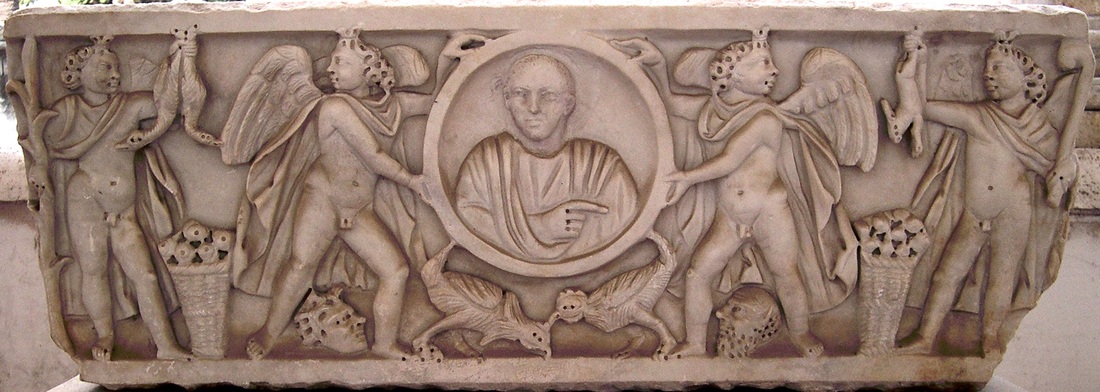 Season sarcophagus with recut portrait. Middle of the third century AD. Rome, Baths of Diocletian.  Why does this young man appear to be sprouting phantasmic locks of hair from above his left ear? It seems that he's shadowed by the ghostly ponytail of the coffin's previous owner. The portrait has clearly been recut, and the original must have showed a boy devoted to the goddess Isis: her young male followers proclaimed their devotion by shaving their heads, razoring off everything except a single long tuft of hair above the ear. (The hairstyle was modelled on that of the mythic child Harpocrates, son of Isis.) Sheer need must have driven the later family to choose this piece — with its prior owner's prominently protruding hairstyle — for reappropration and recutting. Why not choose one with a portrait of a non-devotee, whose hair would be much less troublesome to erase? Or else simply make better use of abrasives to take down the background plane around the head, fully scrubbing off any lingering halo? Clearly money — or time — was limited, and the family made do with the used piece they had at hand: a striking reminder of the exigencies of death, the high rates of infant mortality in the ancient world, and above all, the frequent recarving and reuse of sarcophagi in antiquity by Romans themselves. ADDENDUM I return to this piece in a later post: The Phantom Ponytail returns. Comments warmly invited. (Both the Facebook system below, and the traditional comment form, work dandily.) |
Roman
|